Site Decor – Build Team Handbook

As a member of the Site Decor – Build Team you are responsible for reading this Handbook

On the following pages there is some key information for you. But also a list of actions for you to do now.  Please do this as soon as possible, I would like the questionnaire information by the 14th June, so that we can prepare for your arrival. 

  • Introduction

    The Site Decor Build Week team at Greenbelt includes about fifty volunteers of all ages and from a wide range of backgrounds, and creative and practical skill sets. Our aim is to enliven the site, making focal points and creating distinctive places and characterful venues.

    As a member of the team you have a vital role, you will be involved in decorating most of the 40 locations across the festival site. You volunteered to be part of this team, because you are energetic and creative, and would like to be part of the team that brings life to venues across the festival.

    Saga Site Decor Producer, Greenbelt staff 

    saga@greenbelt.org.uk 

    Helen Saga’s PA on site, and Team Admin during year.

    helenrickards@hotmail.com

    Beverly AND LENAA Team CATERERS


    Al  Barn and Flatbed Team Leaders


    Abi Bunting Team Leader


    Peter Hard Decor Team Leaders


    TBC Rigging Team Leader


    Susie and Liane Soft Decor Team Leaders


    Tracie and Ted Waymarkers Team Leader


    We are here to help and guide you in your role. We are your first point of contact on site and in advance. 

    Read More
  • Arrival & Departure Dates

    Arrival – Sunday 23rd August between 12-1pm.

    Departure – Monday 31st August after 4pm

    Read More
  • Our expectations of you

    Our expectations of you:

    • need to be self-motivated.
    • need to be confident enough to mix with your team, and other team members.
    • will be responsible for reading information sent out before the festival, and responding, if needed.
    • will be responsible for ensuring that you get enough sleep, so that you can carry out your role safely. 
    • will be responsible for being ready for duties on time. 
    • will be responsible for your own belongings.
    Read More
  • What You Can Expect From Greenbelt

    To support you in your role Greenbelt (we provide 3 meals per day on Monday- Thursday and on Monday. This is a combination of team catering and crew catering, plus vouchers for a celebratory meal on the Thursday) offers a package including food vouchers to contribute to a meal or snack for each six to seven-hour shift completed, discount vouchers for the Festival Guide, Jesus Arms drink voucher, discounted talks voucher, free showers, training and briefing and support for your role and – of course – entry to the festival. 

    There will, again, be a limited-edition Greenbelt 2025 Volunteer t-shirt that you will be able to buy. More details of this will be sent out in July.

    As well as all that, you’ll be able to develop new skills, make new friends, face a fresh challenge, make your own contribution as part of a team – and hopefully have fun too!

    We work hard to make volunteering opportunities open to everyone and try to match people to the roles which will suit them best. We listen to your feedback and make improvements wherever we can. We aim to provide a positive and friendly atmosphere in each team, so that you’ll enjoy your weekend as much as you can. Greenbelt wouldn’t happen without you.

    Read More
  • PACKING LIST 

    DOWNLOAD A PDF VERSION OF THIS LIST HERE

    These items are considered essential, based on many years of organising volunteer camps and workshops. Please let us know in advance if sourcing any of these items would be difficult, as we may be able to help.

    This week involves hands-on making, outdoor work, and dusty conditions. Please bring clothes and items you don’t mind getting dirty, stained, or worn.

    We also recommend reading the “Hygiene & Site Conditions” , “Workshop Clothing Packing List ” “PPE” sections of the handbook carefully

    Camping & Sleeping

    • Tent
    • Sleeping bag (suitable for cold nights)
    • Pillow
    • Airbed, roll mat, self-inflating mattress, or camp bed
    • Warm bedding (additional blanket or liner strongly recommended)
    • Extra insulation for cold nights (e.g. blanket or quilt)

    Clothing

    Workwear (for workshop and build work)
    During the working day, suitable close-fitting clothing must be worn, and long hair must be tied back and kept away from the face at all times for health and safety.

    • Knee-length shorts or full-length trousers made from durable workwear materials such as thick cotton twill, denim, or similar hard-wearing fabric. Mid-thigh shorts, lightweight fashion shorts, thin leggings or loose/baggy clothing that could get caught in tools are not suitable.
    • T-shirts, long-sleeved shirts, or sweatshirts that you are comfortable getting dirty and working in Tops must fully cover the shoulders, back, and midriff. Vest tops, crop tops, and low-coverage tops are not suitable workshop clothin
    • Sturdy walking boots (minimum requirement)
    • Steel-toe safety boots (can be provided if needed)

    Downtime / Campsite Clothing
    Clothing for evenings, rest time, and campsite use. Prioritise comfortable layers and practical clothing suitable for outdoor living selected with variable UK weather conditions and evening insects in mind.

    • Comfortable casual clothing for evenings
    • Warm layers (hoodies, jumpers, fleece)
    • Very warm layer for night-time (insulated jacket or thick jumper)
    • Waterproof coat and waterproof trousers
    • Underwear and socks for the week (extra socks strongly recommended)
    • Sleepwear suitable for cold nights
    • Hat/beanie for cold evenings
    • Sun hat (for daytime protection)
    • Comfortable shoes for campsite use
    • Flip flops or Crocs for showers and washing areas

    Wet Weather & Cold Weather (Essential Additions)

    • Fully waterproof jacket (not water-resistant)
    • Waterproof trousers
    • Warm insulating layers (fleece, thermal base layers, hoodies)
    • Hat/beanie
    • Gloves
    • Extra dry socks

    Washing & Hygiene (Limited Facilities)

    • Toiletries suitable for flannel washing
    • Flannels (2–3 recommended), 
    • Towels
    • Wet wipes or biodegradable wipes
    • Deodorant and basic hygiene products
    • Dressing gown (optional but useful when the showers are installed)

    Personal Care (Hot, Dusty Conditions)

    • High-factor sun cream
    • Lip balm with SPF
    • Insect repellent
    • Hand sanitiser
    • Moisturiser for hands 
    • Moisturiser for face

    Equipment

    • Refillable water bottle
    • Torch or head torch (no lighting on site at night)
    • Phone charger and battery pack (labelled with your name)
    • Snacks (no shops nearby)

    Optional Comfort Items

    • Camping chair or ground mat
    • Picnic blanket
    • Books/cards/entertainment for downtime
    Read More
  • Site Orientation

    WHAT3WORDS is a good way to explore and communicate locations.
    https://what3words.com/sprouts.wreck.tractor

    Every 3 metre square of the world has been given a unique combination of three words. Used for e-commerce and delivery, navigation, emergencies and more.
    Here is a list of locations that are useful for us.

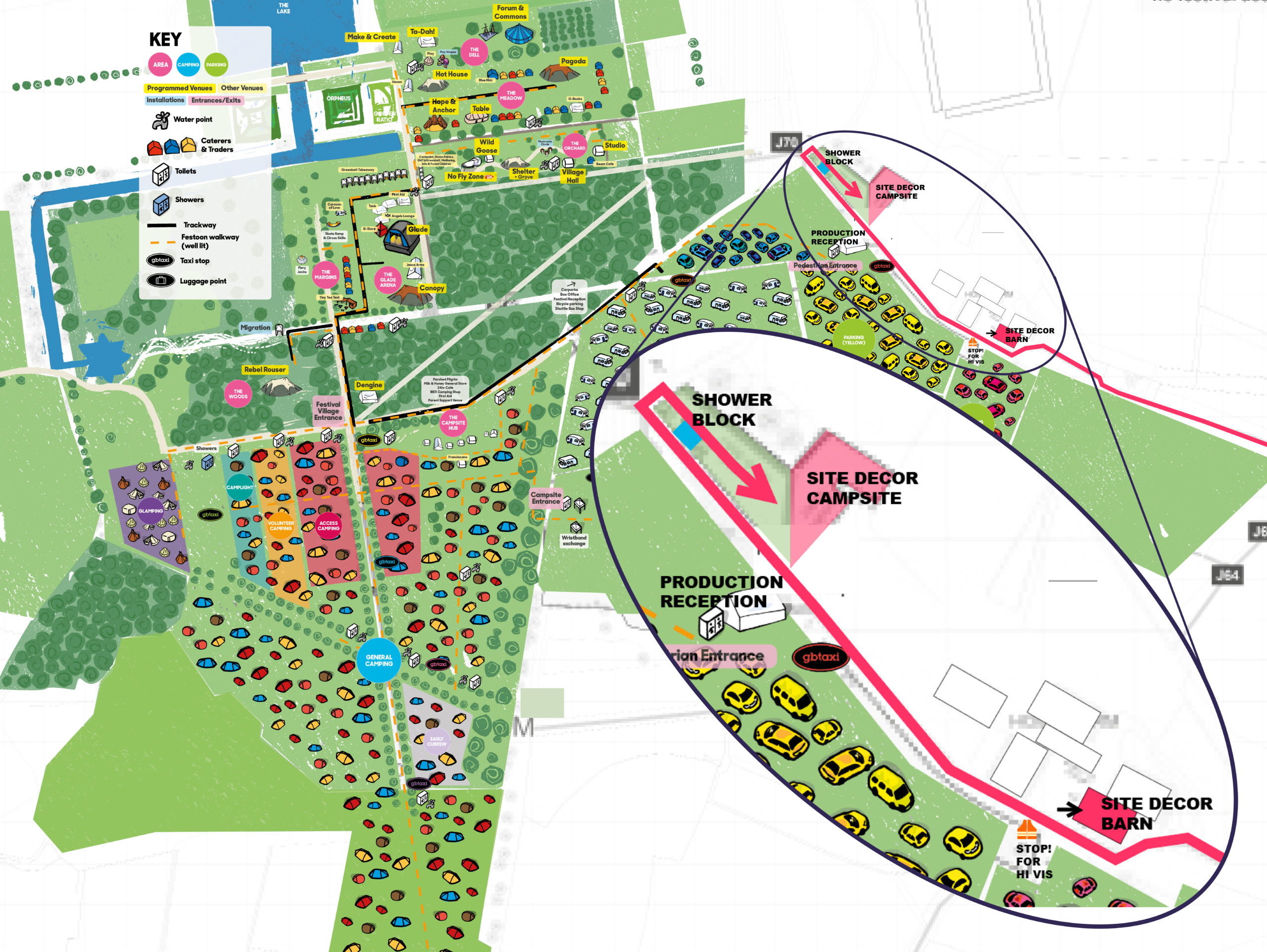
    Site Entrance: ///sprouts.wreck.tractor
    You can only access the festival site via this entrance.

    Hi Vis Pick Up: ///prospered.basket.treetop
    Stop here and collect Hi Vis Jacket when you arrive on site.

    Production Reception: ///scrapped.novel.builds
    Stop here on arrival before to sign in, to confirm site induction has been completed.

    Entrance to our campsite: ///curated.darker.streamers
    You can drive into the campsite.

    Caravans and Campervan zone in our campsite: ///mermaids.renders.studs
    One of our team will be in the campsite, so guide you to a suitable camp spot.

    WC: ///snow.polishing.salad

    Showers: ///eased.formless.districts

    Crewcatering: ///eggplants.crafted.cones

    We expect showers to arrive and be plumbed in by end of Wednesday 19th August.
    These are for use by our team and professional site and security crew.

    Barn: ///prune.down.pilots
    The site decor barn is accessed from the West.

    These are some of the key locations on site: 

    Glade Arena: ///pillow.shrub.streamers

    Hurried Over: ///survived.applause.broached

    Campsite Hub: ///infants.dares.birthing

    Rebel Rouser: ///verb.chatters.beans

    Read More
  • CAMPING

    We have a dedicated campsite that is conveniently located for both the Pre-Festival and Festival periods. However, please note that this is separate from the main festival campsite.

    For many members of the team, this dedicated area is considered a positive part of the volunteering experience. It provides a quieter, more focused environment during the build and event period.

    However, it is not appropriate for inviting additional festival attendees or friends. If you wish to camp with friends or a wider group, you will need to move to the main campsite. This move should be arranged for the evening of Thursday and you will need to make time for this during that period.

    Please also note that during the Make and Build weeks it is not possible to camp in the main campsite.

    Read More
  • WORKSHOP CLOTHING

    During the working day, suitable close-fitting clothing should be worn, and long hair must be tied back and kept away from the face. Volunteers should wear knee-length shorts or full-length trousers made from durable materials such as thick cotton twill or denim. Mid-thigh shorts are not suitable.

    Suitable tops include T-shirts, long-sleeved shirts, or sweatshirts that you are comfortable getting dirty while working. Tops should cover the shoulders, back, and midriff to provide better protection when lifting, carrying, or using tools. Vest tops are not suitable workshop clothing.

    Sturdy, close-toed trainers or walking boots are essential at all times, and steel-toed safety boots are strongly recommended where available. Safety boots can be provided if you do not have your own.

    Read More
  • Personal Protective Equipment (PPE)

    You must wear a Hi Vis jacket at all times- everywhere on the site day or night. You are required to wear steel toed boots or very sturdy walking boots inside the barn or working outside on site. All volunteers must wear appropriate Personal Protective Equipment (PPE) when using tools or carrying out tasks that may present a risk of injury, which means you may need to wear ear plugs, ear defenders, gloves or safety specs if the task requires it. For this project I expect that you will need to wear safety gloves. If you have your own PPE, please bring them you may find this more comfortable.

    Read More
  • HYGIENE

    There is a mobile shower unit with hot water in the camping area for our use, and portoloos.

    You should expect to combine showering with basic campsite methods (such as a flannel wash or wet wipes) whilst you are on site. Please bring flannels, towels, and wipes or similar washing essentials to help you stay comfortable and clean. A full coverage dressing gown, flip flops and a bag for toiletries and clothing are useful for when using the showers.

    As washing facilities will be limited, and working conditions can be dusty and dirty, it is important to plan for both comfort and protection during the day. We recommend bringing a sun hat, which will help protect against sun exposure and also reduce the amount of dust and dirt getting into your hair. Simple hygiene routines are strongly encouraged where possible, including changing clothes regularly, washing hands, and freshening up each day.

    For health and safety all volunteers with long hair must keep it tied up or in braids while working. This also helps with comfort and hygiene in dusty conditions.

    For volunteers with Afro hair, it may be helpful to arrive with protective styles already in place, along with essential hair care items such as leave-in conditioner, oils, a wide-tooth comb, and a satin or silk head covering (bonnet or scarf). Limited washing facilities and dusty working conditions can make hair care more challenging, so planning ahead with low-maintenance protective routines is strongly recommended

    Read More
  • Periods and Sanitary Care

    Living and working in a field for a week brings a unique set of challenges, including managing periods. The guidance below is designed to help you stay comfortable while also supporting sustainable site management.

    We recommend bringing your preferred sanitary supplies with you. However, if you need additional products during the event, a small emergency supply is available in the Mirror Cabinet in the Barn Loo.

    During the festival, support is also available from First Aid and the Information Point if required.

    Disposal of Sanitary Products
    Across the site there are different types of toilets, and disposal options vary.

    Portaloo toilets (plastic units)

    Sanitary towels may be disposed of in portaloo bins. While tampons and pads can technically be flushed in these systems, we strongly encourage you not to do so. Flushing increases water processing demand after the event and has a greater environmental impact.

    Where possible, please wrap sanitary products in toilet paper and dispose of them in the nearest general waste bin.

    However, we recognise this may not always be practical, and individual choice should be respected.

    Compost toilets (long drops)

    Sanitary products must not be placed in compost toilets under any circumstances.

    Please wrap products in toilet paper and dispose of them in the nearest general waste bin.

    Menstrual Cups (Moon Cups)

    For menstrual cup users during Make and Build Week, the Barn has access to plumbed toilets with running water, which can be used for washing and rinsing.

    A flask of hot water may also be useful for comfort or cleaning while on site or at camp.

    During the festival, there are accessible toilets with running water available on site, which can be used if needed for rinsing.

    Please be mindful that these facilities are primarily intended for people with disabilities and access needs, who may not have alternative options. Where possible, use these facilities considerately and avoid unnecessary delay.

    Read More
  • Volunteer Training

    All volunteers must complete a mandatory briefing/training session every year. It must be completed before you arrive on-site – without it, you will not be permitted to volunteer.

    This year, the mandatory briefing is moving online and must be completed before arriving, rather than on-site as in previous years.

    • Structure: The training is broken down into 7 short chapters, featuring a quick video intro and three summary questions for each section. 
    • Time Commitment: It should take you less than an hour to complete from start to finish. But if you’re logged into a google account you can save part way through. 
    • Screens: We recommend completing this on an laptop or desktop computer for the smoothest video viewing experience.
    • Once complete: you will be sent email confirmation, please save this and show it to the reception teams when you arrive. 

    ACTION: Please access and complete the training using this link 

    If you have any questions about this content or technical issues, you can let us know at training@greenbelt.org.uk.


    This is separate from any team-specific briefing, where your Team Leader will walk you through festival information, safety guidelines, and role-specific instructions. Your Team Leader will confirm the time and location of that session directly, if needed.

    Read More
  • Volunteer T-shirt

    There’s a limited-edition Greenbelt 2026 Volunteers t-shirt. If you haven’t ordered your teeshirt, by the 1st July, you may be able to buy one at the volunteer lounge – it opens on Wednesday  at 9am.

    Standard Vol Tee  |  Fitted Vol Tee


    Read More
  • ARRIVAL BY TRAIN

    If you are travelling by train, the nearest station is Kettering Railway Station. Where possible, we will try to arrange collection from the station or put you in touch with other volunteers arriving at similar times so that you can coordinate travel together.

    If tickets are already available, we recommend booking as early as possible to get the best prices.

    When searching on Trainline or other booking websites, please use the following suggested journey times:

    Arrival: Kettering — 23rd August, around 12:00
    Departure: Kettering — 31 August, around 16:30

    Read More
  • ARRIVAL BY VEHICLE

    If you are arriving by private vehicle, please use the following exact address for Google Maps:

    Greenbelt Festival, Boughton Estate, Near Home Farm, Kettering
    Kettering NN14 3AG

    Arrival & Departure Times
    Arrival: 23 August, 12-13:00
    Departure: 31 August, 16:30

    We strongly recommend using What3Words to familairise your self with site entrances and key locations, there is often poor signal when you are nearby :

    Entrance from Warkton Road: https://w3w.co/sprouts.wreck.tractor
    Arrival check-in point (look for the orange flag — stop here to collect a hi-vis jacket and sign in): https://w3s.co/prospered.basket.treetop
    Site Decor Barn: https://w3w.co/heaven.intervals.moods
    Festival weekend entrance: https://w3s.co/sprouts.wreck.tractor
    Campsite location: Coming soon

    Additional travel information will also be shared in the WhatsApp groups, which we encourage all volunteers to join.

    Read More
  • Electric Car Charging

    Regrettably, we are currently unable to offer electric car charging points. Please ensure you have enough charge for getting on and off site. Here are some nearby charging points. 

    For more information, visit www.greenbelt.org.uk/info/travel

    Read More
  • WORKING AT HEIGHT

    Working at height on uneven terrain is a common part of installation work. It also introduces additional risk compared to flat or indoor environments.

    This guide sets out safe and consistent practice for using ladders on site.

    Core Principle
    If the ladder cannot be set safely, it must not be used.

    No installation task is so urgent that it justifies unsafe working at height.

    Even low-level use (two or three steps) can present risk and must be treated with care.

    Training and Preparation
    A ladder training and familiarisation session will take place on Sunday afternoon.

    This will cover:

    • Opening and closing ladders safely
    • Moving and positioning ladders
    • Safe setup on uneven ground
    • Correct working position and control
    • All team members must ensure they are confident in safe ladder use before working independently at height.

    Site Conditions
    Before using a ladder, always assess the ground:

    • Uneven or sloping ground increases instability
    • Soft ground (mud, grass, recently disturbed soil) may cause sinking
    • Loose materials can cause ladder feet to shift
    • Wind exposure significantly increases risk
    • If the ground cannot provide stable support, reposition the ladder or use an alternative method.

    Ladder Setup
    Ladders must always be:

    • Fully inspected before use (feet, rungs, frame, and restraints)
      Placed on firm, stable ground
    • Positioned at the correct angle (approximately 1:4 where applicable)
    • Secured at the base and, where possible, at the top
    • Fully opened with spreader bars/stays locked in place before use

    On uneven ground:

    • Only use ladders on surfaces that can be made stable and secure
    • Use purpose-made stabilisation methods where required
    • Reposition the ladder rather than forcing it onto unstable footing
    • Do not use makeshift supports (bricks, pallets, loose materials, etc.)

    Safe Use
    When working on a ladder:

    • Ladders must always be used as a team of three:
    • One person climbing and working on the ladder
    • One person footing the ladder and actively stabilising it at the base
    • One person supporting by passing tools and materials
    • The person footing the ladder plays an active safety role and is responsible for maintaining stability of the ladder throughout use
    • Maintain three points of contact wherever possible
    • Do not overreach — climb down and reposition the ladder
    • Only one person may be on the ladder at a time
    • Do not stand on the top step or top cap
    • Always face the work — do not work sideways from a stepladder
    • Do not carry heavy or unbalanced loads while climbing
    • Keep tools and materials minimal, secure, and controlled
    • If conditions change (wind, ground movement, instability), stop immediately and reset the setup.

    Working on Installation Sites
    Because installation work takes place on temporary structures and open ground:

    • Always check ladder stability immediately before use, not just during setup
    • Re-check if the ladder has been moved or left unattended
    • Be aware of other team members working nearby who may affect stability
    • Keep the base and surrounding area clear at all times

    Stop Work Rule
    Stop immediately if:

    • The ladder feels unstable or shifts under load
    • Ground conditions worsen
    • Safe positioning cannot be maintained
    • There is any uncertainty about setup or safety
    • Reset, reassess, or use an alternative method.

    Equipment Condition and Reporting
    If a ladder is damaged or not functioning correctly (including feet, rungs, frame, or spreader bars):

    • Stop using it immediately
    • Inform your team leader
    • The ladder must be removed from use and returned to the Barn
    • Clearly label it as damaged using tape and a permanent marker

    Shared Responsibility

    All team members are responsible for safe ladder use.

    If unsafe practice is observed, stop work and raise it immediately.

    Safety always takes priority over speed or convenience.

    Read More
  • ROPE HANDLING

    Many of the Site Decor teams use rope and tie knots to install decor. You will find it useful if you take some time to learn a few knots before you arrive on site. You may already be familiar with some.

    1. The Basic Truckers Hitch

    The trucker’s hitch is arguably the most useful knot for marquee work if you need to create tight, tensioned lines.

    The idea is that the knot system acts a bit like a pulley, allowing a moderate pulling force to generate significantly greater tension in the line.

    Why it’s useful in marquees:

    • Tightening support lines for drapes and swags.
    • Creating straight runs for fairy lights or festoon lighting.
    • Tensioning ropes that support floral installations.
    • Securing items so they don’t sag throughout an event.

    Why it’s useful compared with simply pulling a rope tight and tying it off:

    • You can achieve much higher tension.
    • The line stays neater.
    • It’s relatively easy to adjust or remove later.

    https://www.wikihow.com/Tie-a-Trucker’s-Hitch

    2. Round Turn and Two Half Hitches

    Why learn it:

    • Secure under tension.
    • Easy to adjust while setting up.
    • Excellent around smooth metal tubing.

    Typical use:

    • Securing guy lines.
    • Hanging heavier decor pieces.
    • Attaching support ropes to marquee structures

    https://wiki.6ksg.org/Round_turn_and_two_half-hitches

    3. Bowline

    Why learn it:

    • Creates a fixed loop that won’t tighten under load.
    • Great for attaching ropes to marquee frames, stakes, truss, or anchor points.
    • Easy to untie even after being loaded.

    Typical use:

    • Creating attachment loops for bunting, drapes, festoon lighting support lines, or tensioning systems

    https://www.wikihow.com/Tie-a-Bowline-Knot
    3 Ways to Tie a Bowline Knot – wikiHow

    4. Coiling rope

    It is also good to be able to coil rope, so that it isn’tleft in a tangled mess.
    https://www.wikihow.com/Store-Rope

    “Start with the rope straight. Hold one end, then make evenly sized loops and stack them in your hand. Keep the rope from twisting as you go. When you reach the end, use the remaining rope to wrap around the middle of the coil and secure it. The goal is a coil that can be carried and unrolled without tangling.”

    Read More
  • Safe lifting principles

    Adhering to correct manual handling techniques protects your spine and muscles from injury:

    • Plan Ahead: Assess the weight and shape of the load. Ensure your path is clear of tripping hazards.
    • Stable Base: Stand with your feet shoulder-width apart, with one foot slightly in front of the other to maintain balance.
    • Legs Over Back: Squat down and bend your knees. Lift with your leg muscles, which are naturally stronger, instead of bending over at the waist.
    • Keep It Close: Hold the load as close to your waist and body as possible. The heaviest side of the object should rest against your torso.
    • No Twisting: Keep your shoulders level and facing the same direction as your hips. Pivot smoothly on your feet instead of twisting your spine when turning.
    • Good Grip: Hug the load or use handles where possible rather than gripping with just your fingertips.
    • Smooth Movement: Lift and set down the load smoothly without any jerking or sudden movements.

    Manual handling tips

    Read More
  • SCHEDULE

    Sunday 23rd August

    Arrive between 12-1pm 
    Please bring a packed lunch with you, there will be no ‘official’ lunch time.
    Set up camp.

    2pm we will meet as a whole Site Decor team, and then will break into the sub teams. You will meet your team leader and fellow team members. 
    2.30-4 Team specific training that is necessary for you to prepare for the tasks you will be doing. Including working at height training, use of key tools and techniques. Without doing this session you will be unable to participate. 
    4-4.30 Tea Break
    4.30-6 Site Walk to familiarise yourselves with site layout and location of your projects
    6.00-8.00 Evening Meal Our first group meal will be a chance to socialise and to get to know the wider team. 

    Monday 24th 
    Tuesday 25th
    Wednesday 26th
    Thursday 27st

    7.30-8.15 Breakfast
    9-12.30 Installations on site
    12.30-1.30 Lunch 
    1.30-5.00 Installations on site
    6.00-7.00 Evening Meal
    7.00 > Free Time

    Monday 31st August

    7.30-8 Breakfast
    8-12.30 De Rig 
    12.30-1 Lunch and Pack up camp.
    1-3pm De Rig
    4pm > You are committed to help de-rig until 3pm, Please plan to take down your tent and leave after this.  If you are willing to stay on until 3pm Tuesday 1st please let us know as we need some help to make sure the decor is put away well. 

    Read More
  • MEALS

    We offer 3 meals per day to the Site Decor Team. 

    We accommodate dietary requirements as far as possible, so long as you have informed us on the questionnaire. 

    There will be a rota for setting up and clearing breakfast and evening meal provision. 

    Aside from a good sized bowl for cereal and soup, a mug and cutlery you don’t need to bring any camping catering equipment for use during Build Week, you may wish to have some for the festival itself.

    Breakfast
    A breakfast buffet in the campsite  each morning- with a range of cereals, fruit, teas, coffee and juice.

    Tea Breaks
    Fill your thermos up at breakfast time so you have a hot drink for tea break. Team leader will have a supply of biscuits and cake.

    Lunch
    Pro Catering Hot Lunch

    Evening meal
    Home made soup with fresh bread made for us by team member Sue. 
    Plus something sweet. 

    On Thursday evening we celebrate the festival opening and our successes, by eating a meal from the festival traders on site. 

    Read More
  • Sustainability

    Our approach is simple: we reduce waste, reuse materials wherever possible, and ensure nothing is left behind on site.

    Core Principles

    We are working with materials that are valuable, reusable, and often handmade.

    • We minimise waste wherever possible
    • We prioritise reuse over disposal
    • We treat all materials as long-term assets
    • We leave no trace on the land

    Nothing is left behind, and nothing reusable is thrown away.

    Waste Streams

    All of our site decor waste should be returned to the Barn where you can separate it.

    Please sort materials into the correct containers:

    • Cable ties and offcuts (collected for dedicated recycling)
    • Wood waste (separated and stored appropriately)
    • Paper
    • Cardboard
    • Soft plastics
    • Fabric waste
    • Aerosols and Paint Tins
    • Batteries
    • Metal

    If you are unsure where something goes, please ask before disposing of it.

    • General Practices (Barn)
    • Source and reuse materials wherever possible
    • Store items carefully to avoid unnecessary damage
    • Switch off equipment when not in use
    • Keep work areas tidy and clear throughout the day
    • Food Waste (Barn Kitchen)

    A dedicated food waste bin is available in the Barn kitchen and dining area.

    • All food scraps and leftovers must go into this bin
    • Food waste must never be placed in workshop bins
    • Site – Installation Area (Field Work)
    • Working Environment

    We are working on open land that is later used for grazing.

    This means:

    • All materials must be fully removed after use
    • No litter can be left behind
    • Even small items can cause harm to animals and the environment
    • Cable Ties and Fixings

    Cable ties and plastic fixings must be used carefully and sparingly.

    • Use only what is required for secure installation
    • Do not overuse or double up unnecessarily
    • Do not cut or discard usable ties

    All removed cable ties must be collected and returned for recycling.

    Cable ties must never be placed in general waste or left on the ground.

    Litter and Site Cleanliness

    No litter must be left on site at any time.

    This includes:

    • Plastic offcuts
    • Packaging
    • Cable ties and fixings
    • Tape and wrapping materials
    • Personal waste

    All team members are responsible for maintaining a clean site throughout installation, not only at the end.

    Because the land is used for grazing after the festival, even small items of waste can cause serious harm. Every item must be removed.

    Flags, Bunting, and Decorative Materials

    Flags, bunting, and decorative materials are valuable, reusable assets generously made by volunteers.

    These materials are designed for long-term reuse and must be treated with care.

    • Handle all materials carefully during installation and removal
    • Avoid unnecessary cutting or alteration on site
    • Any cutting or structural change must be approved by Abi or Saga
    • Ensure all components are returned after de-installation
    • Damp or Wet materials must be dry before storing them: Initially this means placing them in the designated wet pile in the barn: Damp materials must not be stored, as this will cause mould, damage, and loss of reusable stock
    • End of Work Responsibility

    Before leaving site, the team must ensure:

    • All materials have been collected and returned
    • No cable ties or fixings remain on the ground
    • No packaging or litter is left behind
    • Wet materials are correctly separated
    • The site is visually clean and safe

    If in doubt: check and take it with you.

    Closing Principle

    We are temporary guests on this land.

    Everything we install is part of a longer cycle of reuse, care, and responsibility. Leaving no trace is not just a rule — it is part of how we respect the place, the people, and the work that continues after us.

    Read More
  • Campsite Waste

    Please use the correct bins provided:

    ♻️ Dry recycling: tins, cans, paper, and Tetra Pak
    🗑️ General waste: non-recyclable items only (black bins)
    🍽️ Food Waste in SD Catering Tent

    Read More
  • Phone charging

    We know you will want to have your phone with you, and we find it helpful for contacting you too. Please bring a charging bank, that it labelled with your name. Bev and Lena will make sure these are charged during the day, after you drop it off at breakfast You are not permitted to plug your phone or charger in yourself, as there are too many people in the team.

    Read More
  • Support

    Pre- festival support 

    While there is no formal Volunteer Support team on site during Make and Build Week. If you’re feeling a bit lost, over tired or overwhelmed –  please speak to Helen in the Site Decor Team. 

    Support During the Festival 

    If you have a problem you’d like to chat about – big or small, personal or practical, if you’re feeling a bit lost, over tired or overwhelmed – we have a team to help you out. The Volunteer Support Team will call into your venue during the weekend to find out how you’re getting on or you can contact them via the Volunteers’ Lounge info desk. Members of the Volunteer Support team wear purple hi vis jackets. 

    As well as the specific support for volunteers we also have the Festival Wellbeing, who are based in the Festival Village. Team members, who wear pale blue hi-vis, will be available for anyone, should they feel overwhelmed by something they have listened to onsite, or if they just need someone to talk to. The team will be based near the information point. 

    Read More
  • Insurance

    All volunteers are covered by Greenbelt’s liability insurance. Unfortunately, Greenbelt is unable to insure any personal items you bring with you to site, unless agreed in advance with the Event Manager. There is no secure storage provided at the festival. Please make sure your own insurance policy covers any items you decide to bring with you.

    Read More
  • First Aid

    Trained First Aiders
    The trained first aiders within the volunteer team are:

    • Saga
    • Peter
    • Abi
    • Liane
    • Tracie

    From Monday onwards, a Build Medic will be based at the First Aid Point in the Glade Arena.

    First Aid Locations
    The primary first aid locations on the festival build site are:

    • Glade Arena First Aid Point (Build Medic available from Monday)
    • Barn downstairs bathroom (wall mounted first aid kit- please be aware there is not a first aider always there)

    If you’re in need of help or cannot walk to a first aider, please find your nearest radio holder or use your radio if you have one. Some static points;

    • Production Reception (at the “top of the hill’)
    • Production Office (at the “bottom of the hill”)
    • But there are often people roaming or working nearby with radios who can be asked to help.

    [Radio channel info TBC]

    For minor cuts, grazes and scrapes, basic first aid supplies such as plasters are available in the bathroom mirror cupboard. Please do not use the green first aid kit for minor injuries, as it must remain fully stocked and available for more serious incidents.

    Non-Urgent First Aid – Walking wounded

    Not all incidents require an urgent response.

    For minor injuries or illnesses, volunteers should contact their Team Leader or walk to the Build Medic in the first instance. Team Leaders are equipped with radios and can provide guidance or arrange assistance if required.

    Where possible, volunteers requiring first aid treatment should attend the Glade Arena First Aid Point and be assessed by the Build Medic.

    If a volunteer is unable to travel to the First Aid Point, the Team Leader should contact Medic by radio to request assistance.

    Emergency Response

    In the event of a very serious injury, illness, or incident requiring an emergency response:

    • Call 999 immediately if it is a life threatening emergency.
    • Get Medic from Glade Area via radio or in person
    • Provide the casualty’s condition and precise location.
    • Notify the nearest Team Leader that you have done so.

    TEAM LEADERS: anything requiring medic attention let Saga know as soon as is appropriate. If there is an active and ongoing emergency please inform her immediately.

    Do not move an injured person unless they are in immediate danger. Always prioritise your own safety. Location Information

    Should you need it, a precise location can be provided to Emergency Services using the What3Words app. Please download this app to your mobile phone.

    Key locations (such as Glade, Hurried Over etc) are on a poster in the barn.

    Illness and Welfare Support

    If you become unwell in the campsite please contact Beverly, Lina or Helen.

    We will make sure you are cared for and can access appropriate support. Where necessary, a first aider will assess the situation and help determine whether further medical attention is required.

    Please let someone know as soon as possible if you are feeling unwell. Early support can often prevent a minor issue from becoming more serious.

    If you are seriously unwell, experiencing difficulty breathing, severe allergic reactions, chest pain, loss of consciousness, or any other medical emergency, seek immediate assistance from a first aider and call 999 if required.

    Read More
  • Pre-festival Photos

    Please do not share photos of the festival site on social media (including on the Unofficial Greenbelt Facebook page) until the festival opens.

    Read More
  • Volunteers welcome session

    Thursday 27that 4pm in the Jesus Arms.

    Unless the weather is against us and we are stuck in the thick of things the whole team will gather at the Jesus Arms at 4pm – a chance to meet up with the wider Greenbelt Volunteer Community. Whilst for most volunteers this is a chance to take stock before the weekend and their busyness begins, but for us it’s a chance to celebrate all that we’ve done to transform the site into a colourful and inspiring space.

    It will be a chance to hear from Greenbelt Staff team and be inspired by a couple of our contributors, and then the Jesus Arms will be open for an hour for volunteers only.

    Read More
  • Celebratory Meal

    On Thursday 27th at 6pm you’re invited to a celebratory meal for all Site Decor volunteers. We will make a WhatsApp group to coordinate this during make week. 

    Read More
  • Wristbands, Badges & where to return Hi-Vis

    Your Festival-maker wristband will give you access to the production area, as far as Front Desk, and the Volunteer Lounge. If you need access to other parts of the site, or if your role means you’ve needed to have a DBS check, you will still be issued with an ID badge. Not all volunteers will receive an ID badge.

    As usual, we will be collecting in lanyards and hi-vis so that they can be used again next year. Hi-vis can be returned to Volunteer Information, if you don’t need it once the festival has opened. You can also return it to a steward as you leave site. It would be really helpful if you could close the velcro on the hi-vis, before you return it. If everyone does this, it saves them all getting stuck together in the washing machine!

    Please collect your wristband from Volunteer Reception which is by wristband exchange in Orange carpark.

    Read More
  • Volunteer Lounge & Volunteer Information

    There will be two volunteer lounges at the festival.

    The main – and biggest – lounge will be in the Campsite Hub, near the 24 hour Cafe and Milk & Honey. You will be able to see it as you walk from the Volunteer Reception into the Campsite. Here you’ll be able to talk to Volunteer Information, grab a drink, take a seat and meet up with other volunteers.

    Plus, there is a second lounge, located in the heart of the festival village as quick stopping point for volunteers on shift in the festival village to grab a drink. It’ll be in the Orchard behind the No Fly Zone. This lounge will be much smaller than the main lounge and may not be staffed at all times. 

    Children and others, who are not volunteers, are not allowed in either of the Volunteer Lounges. The Volunteer Lounge team will keep you topped up with hot and cold drinks, biscuits, fruit, toast, soup and maybe even a cake or two. Do bring your own mugs if you can.

    If you’ve got a question or need contact details or directions, the Volunteers’ Lounge has a Volunteer Information desk. The Volunteer Information team will help you with anything you need to find out. There will be notice boards here with important information and updates.

    You can also get your phone charged in the Volunteer Lounge in the campsite. Bring your own charging cable. 

    The Volunteer Lounge will be open from 9am on Wednesday 20th.

    Read More
  • Festival Guides for Volunteers

    Volunteers can purchase a Festival Guide from the Volunteers’ Lounge, from the Wednesday of ‘Build Week’. The Guide provides details of everything on the programme for the weekend.

    You will be able to purchase a guide at the reduced price of £8.00, giving a discount of £4.00, if you use the discount voucher your team leader will give to you at your briefing/training. The discount voucher will be with the drinks vouchers you’ll also receive.

    Read More
  • General Festival Arrival & Departure times

    Boughton House Estate is private property. The area of the estate being used by Greenbelt will be accessible to festivalgoers from 10 am on Thursday 27 August.

    The Festival Village (where the programming and main venues are located) is separate from the Campsite. The Glade Arena (which is a section of the Festival Village) will open from 6 pm on Thursday 27 August and the whole Festival Village will open from 9 am on Friday 28 August.

    At the end of the festival, the Festival Village will NOT be accessible to wristband holders on the morning of Monday 25 August. The Campsite will close at 12-noon on Monday 31 August. Please ensure you are packed up and off-site by this time.

    Read More
  • Press

    You may be asked to comment on items on the programme, particularly about contributors who may be speaking on topics which could be controversial. However innocent this may appear, you may be speaking to a journalist who may take your comments as being made on Greenbelt’s behalf. Please direct any requests of this kind to Daisy Ghira (Greenbelt’s Digital Comms Officer), who can be reached on radio or through Control.

    You can, of course, speak freely with the Greenbelt Social Media Volunteer team, as they’re part of our internal comms and are making content for Greenbelt’s own channels

    Read More
  • Leave no trace

    As Greenbelt campers, please help to ensure you leave no trace of your visit. Please continue to be particularly vigilant about small items such as tent pegs, which can be hazardous to animals.

    Read More
  • Late Information details

    Please check this webpage in the run-up to the festival for latest updates.

    Read More